

New research reveals how collaboration patterns shape corporate innovation output
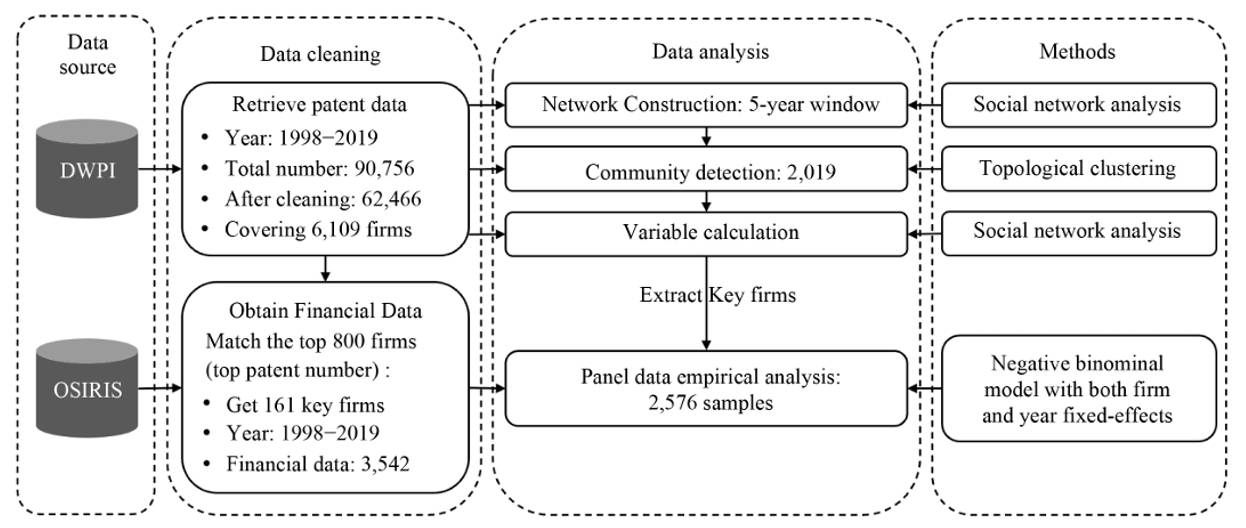
Data collection and analysis.
GA, UNITED STATES, December 25, 2025 /EINPresswire.com/ -- Innovation today unfolds not in isolation but within interconnected ecosystems shaped by collaboration networks. This study demonstrates that a firm’s innovation performance is strongly influenced by how it is embedded in innovation communities. Using 22 years of patent and network data from the global 3D printing industry, researchers find that both within-community and cross-community embeddedness promote higher innovation output. Crucially, collaboration complementarity plays a contingency role—enhancing the returns of within-community ties while reducing the benefits of cross-community connections when complementarity is high. These findings clarify why previous research reported inconsistent results and provide new evidence for how network structure drives innovation outcomes.
Digitalization and globalization accelerate knowledge exchange across firms, fostering open innovation ecosystems where organizations collaborate beyond geographical boundaries. Within these ecosystems, innovation communities—groups of firms that collaborate frequently—enable knowledge sharing, resource access, and mutual learning. Although past studies link embeddedness to innovation, results have been mixed, with some suggesting positive effects, others negative or nonlinear. Little attention has been given to distinguishing within-community and cross-community collaborative structures, nor to understanding how collaboration complementarity alters the relationship. This creates a theoretical gap regarding when embeddedness enhances innovation and when it becomes a burden. Based on these issues, the study conducts an in-depth examination of how innovation community embeddedness affects firms’ innovation performance.
Researchers from Beijing University of Posts and Telecommunications, Tsinghua University, the Higher School of Economics (Russia), and collaborators published (DOI: 10.1007/s42524-025-4188-x) this work in Frontiers of Engineering Management in 2025. The study analyzes global patent data from 6,109 organizations over 22 years, constructing collaboration networks to identify innovation communities using topological clustering methods. By examining within-community and cross-community embeddedness, alongside collaboration complementarity, the research uncovers how network structure and partner diversity jointly shape firms’ innovation performance.
The authors constructed global collaboration networks based on co-patenting activities using rolling five-year windows, identifying innovation communities through Louvain topological clustering. Embeddedness was measured at two levels: within-community embeddedness, representing ties to peers inside the same community, and cross-community embeddedness, reflecting ties that bridge multiple communities. Both relational and structural dimensions were evaluated, and innovation performance was proxied by annual firm-level patent counts. Negative binomial regression models reveal that both embeddedness types significantly enhance innovation output. Within-community connections provide trusted access to shared knowledge, allowing faster resource integration and reducing coordination cost. Cross-community ties offer diverse expertise and non-redundant information, broadening innovation perspectives. However, collaboration complementarity is pivotal: when complementarity is high, firms gain more from within-community relational embeddedness, while the innovation benefits of cross-community collaboration weaken due to integration complexity and resource absorption costs. These insights reconcile contradictory findings in past literature and highlight the importance of balancing local cohesion and external openness for innovation growth.
“Our results highlight that innovation is not only about forming partnerships, but about forming the right partnerships in the right network positions,” the authors said. “Dense internal ties accelerate trust and knowledge transfer, while cross-community ties introduce novel perspectives. Yet, high complementarity does not always guarantee more innovation—it amplifies internal collaboration benefits but increases coordination costs across communities. This means firms should manage their collaboration portfolios strategically rather than expanding cooperation blindly.”
This study offers strategic guidance for firms pursuing innovation advantage. Companies embedded deeply in innovation communities may strengthen internal ties to leverage complementarities, while selectively bridging external communities to maintain diversity of ideas. Policymakers can use these insights to guide industrial cluster development, promote cross-sector collaboration, and design incentive mechanisms for innovation-driven industries. The analytical framework is also applicable to emerging domains such as AI, new materials, and biomanufacturing. Overall, optimizing embeddedness and collaboration patterns can accelerate technological progress and enhance competitiveness in global innovation ecosystems.
DOI
10.1007/s42524-025-4188-x
Original Source URL
https://doi.org/10.1007/s42524-025-4188-x
Funding information
This work was supported by the National Natural Science Foundation of China (Grant Nos. 72272017, L2224047, 71974107, 71872019, and L2424237), the National Social Science Foundation of China (Grant No. 22AZD125), the Beijing Social Science Foundation (Grant No. 22GLA012), the Beijing University of Posts and Telecommunications Interdisciplinary Team Program for the ‘Double First-Class’ Initiative (No. 2023SYLTD11) , the Construction Project of China Knowledge Center for Engineering Sciences and Technology (No. CKCEST-2023-1-7), the National Social Science Foundation of China, and the HSE University Basic Research Program.
Lucy Wang
BioDesign Research
email us here
Legal Disclaimer:
EIN Presswire provides this news content "as is" without warranty of any kind. We do not accept any responsibility or liability for the accuracy, content, images, videos, licenses, completeness, legality, or reliability of the information contained in this article. If you have any complaints or copyright issues related to this article, kindly contact the author above.
